
Escondido Public Records Inventory
California's CPRA makes many records requestable unless an exemption applies, but the law does not move all Escondido records into one database. Each custodian controls its own files, fees, copy rules, and limits. The table below separates open record sets because a deed search, voter-file request, court lookup, and police-record request all follow different rules.
| Record set | Custodian | Online index | Access |
|---|---|---|---|
| Recorded deeds, liens, official records | San Diego Recorder/County Clerk | Official Records Index | Grantor/grantee search; mailed copies; certified copies from ARCC |
| Property ownership and assessor roll | San Diego Assessor | ParcelQuest, phone, kiosks | Ownership and address by phone or kiosk; 25 free vendor searches in 30 days |
| Court, probate, divorce, criminal cases | San Diego Superior Court | Court Index and ROA | Index online; official record at clerk; older indexes in person |
| Vital records | County Recorder or CDPH-VR | Limited indexes | Authorized or informational certified copies; eligibility rules apply |
| Voter registration | California SOS and San Diego Registrar | My Voter Status; voter-file request | Full file only for approved purposes |
| City records | Escondido City Clerk | NextRequest portal | CPRA request for city files across departments |
| Jail and state custody | San Diego Sheriff and CDCR | Who's in Jail; CDCR Inmate Locator | Current custody and state prison searches |
Closed or limited files include juvenile court records, sealed cases, adoption files, confidential voter records, DMV data restricted by DPPA, recent vital-record authorized copies, law-enforcement investigative records, and medical or EMS patient-care files.
Escondido Recorder Public Records
The San Diego County Assessor/Recorder/County Clerk is the main custodian for recorded documents used in Escondido records research. The recorder accepts and records legal documents, keeps birth, marriage, and death records and indices for San Diego County, handles fictitious business names, and maintains notary oath and bond filings. The same office family also houses County Archives for permanent records.
The Official Records Index confirms recorded documents by grantor or grantee. Recent recordings may take 24 to 48 hours to appear. Copy orders placed online are printed the next business day and mailed by regular mail, and the recorder states that purchased images cannot be viewed or printed online. Certified copies are available only from ARCC. That matters when a title, estate, or family-history question needs proof rather than an index hit.
| Field label | Type | Required | Options or notes |
|---|---|---|---|
| Search by grantor/grantee name | Text | Likely yes for name search | Recorder confirms searching by either party name |
| Document type | Dropdown | Unknown | Acclaim supports official records and FBN; exact options not captured |
| Recording date | Date range | Unknown | Useful for narrowing common names |
| Search | Button | Not applicable | Starts lookup after portal terms |
Note: Grantor and grantee are party roles, not proof of current ownership by themselves.
Escondido Assessor Records Access
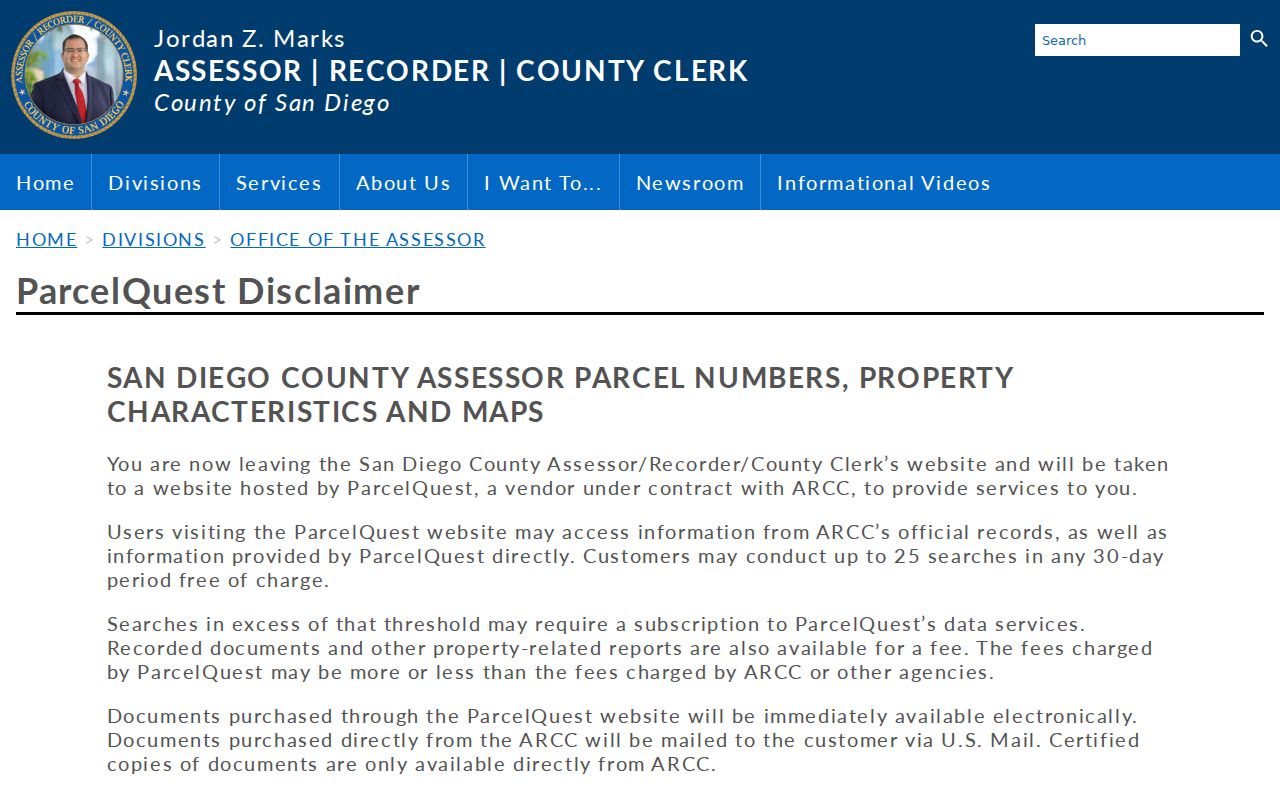
Assessor records are strong for address, parcel, and ownership trails. San Diego County states that property ownership and address information are available by phone through the Assessor Public Information Line and through public kiosks. ParcelQuest supplies APNs, property characteristics, and maps online, but the county treats it as a vendor portal. Users get 25 searches during a 30-day period for free; more searches may require a subscription.
The county also gives a useful warning about copies. Documents purchased through ParcelQuest are available electronically, while documents purchased directly from ARCC are mailed. Certified copies remain ARCC-only. Property-record copies cost $2 for the first page and $0.05 for each additional page in the assessor material captured during research.
The San Diego County ParcelQuest disclaimer explains the search limit and certified-copy caveat.
The best practice is to use the online portal for a lead, then confirm copy or certification needs with ARCC before relying on the document.
Escondido Public Records Portals
Each custodian has a different access channel. Some are true online searches. Others are request portals, courthouse counters, phone lines, kiosks, archives, or mail processes. Escondido records often fail when the request is sent to the wrong office, such as asking City Hall for county deeds or asking ARCC for a divorce file.
San Diego Superior Court
Court Index, ROA, clerk files
Court location dependent
Escondido Court Public Records
San Diego Superior Court supplies two case lookup tools: the Court Index and the Register of Actions. The Court Index finds case number and location for civil, criminal, family, mental health, and probate records. It also warns that charges and dispositions are not shown there. Those details require the official court record at the clerk's business office.
The ROA can show case events and, for some civil, small claims, and probate matters, preview or paid document access. Criminal case documents are not available for online viewing or download. The court says they can be purchased online and mailed after fulfillment. Older records from 1974 forward can be routed by online search or court location, while pre-1974 records require the court location where the case was tried.
- Index
- A pointer to a case or document, not the full official record.
- Register of Actions
- A court event list showing filings, hearings, orders, or document availability where allowed.
- Disposition
- The final outcome or resolution of a charge or case issue.
- Exemption
- A legal reason a custodian may withhold or limit access to a record.
Escondido Vital Record Limits
Vital records have stricter copy rules than many other county indexes. San Diego County Recorder can issue certified copies for births and deaths that occurred in San Diego County and marriage certificates when the marriage license was issued in San Diego County. If no record is found, the county issues a Letter of No Record and keeps the non-refundable processing fee.
California's authorized versus informational copy system is the key access rule. An authorized certified copy requires eligibility, and mail birth requests to CDPH for an authorized copy require a notarized sworn statement. CDPH-VR maintains California birth records since July 1905, and the inspected CDPH birth page listed a $29 birth-copy fee. Divorce files are court records, not recorder records, when filed in San Diego County.
Escondido Custody Records Search
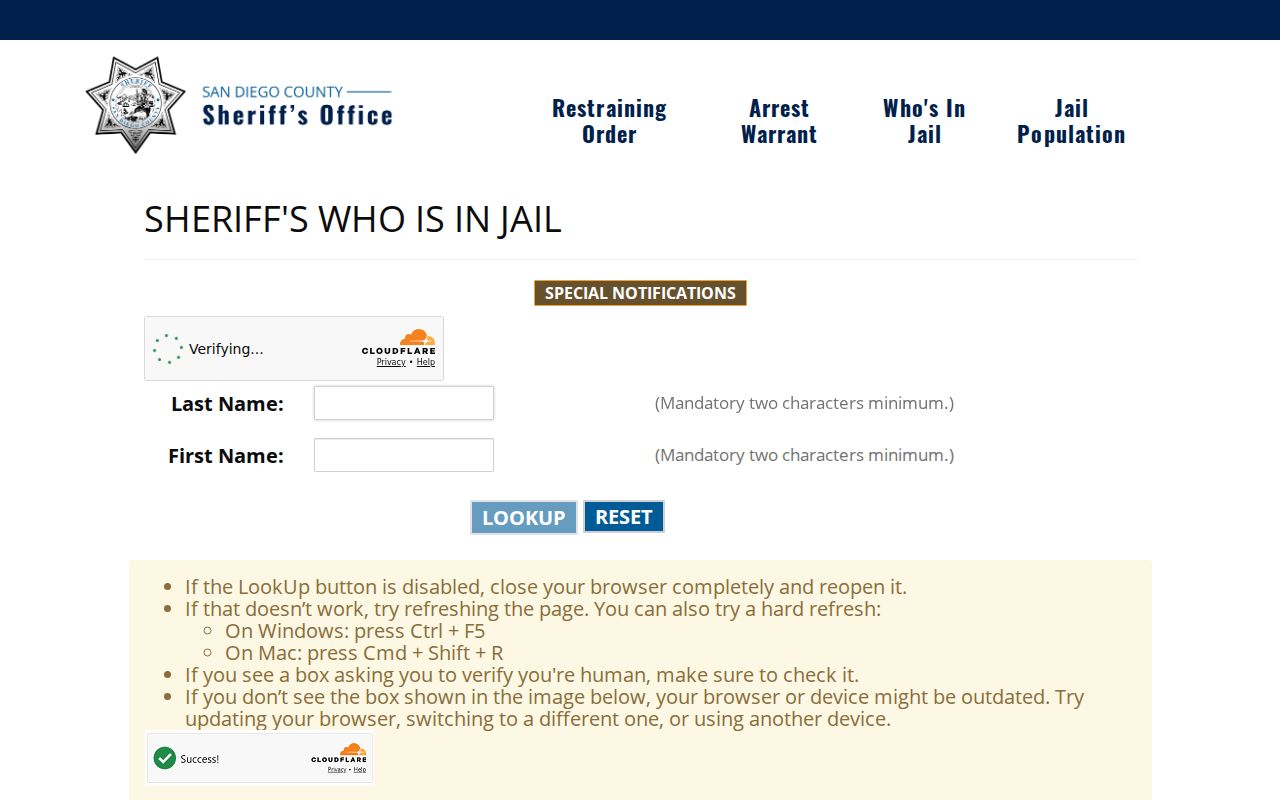
For current county custody records, San Diego County Sheriff's Who's in Jail is the county lookup. State prison records use the CDCR Inmate Locator. The California Megan's Law Website is the state sex-offender registry, operated by DOJ under Penal Code section 290.46 and updated daily by law enforcement according to the state service description.
Law-enforcement records from Escondido Police are not the same as jail rosters. Incident reports and police records are requested through the city records process or police records unit where applicable, and investigative exemptions can limit release. EMS patient-care records are protected and may be released only to the patient or an authorized party with consent.
The San Diego Sheriff Who's in Jail lookup is the county channel for current custody information.
Use custody tools for current official status, not as a complete history of every law-enforcement contact.
Request Escondido Public Records
A CPRA request should go to the custodian that actually holds the file. City emails, permits, code materials, city incident records, and fire-code records route to Escondido through the NextRequest process managed by the City Clerk. County department records may use the county's public-records request center. Deeds, FBN, and vital copies route through ARCC; court files route through Superior Court.
- Identify the custodian by record type before writing the request.
- Check the online index first, because a case number, APN, document number, or date range can make the request clearer.
- Submit the request through the custodian's portal, counter, mail process, or published contact channel.
- Ask for inspection, copies, certification, or a search response based on what the office offers.
- Narrow the request if the office says the scope is too broad or the file belongs elsewhere.
Lawful use. Escondido public records are for lawful personal research, transparency, family history, and safety checks; do not use them to stalk, harass, or intimidate anyone.
Escondido Public Records Offline
Offline access is not a backup detail in San Diego County. It is part of the record system. Assessor owner and address data may be stronger by phone or kiosk than through the vendor web path. Recorder copy orders are mailed. Court Index results must be confirmed with the official clerk record when charges, dispositions, or documents matter.
Older records add more offline steps. Central Division Older Records has indexes from 1880 to mid-1974, with the older run in hardbound books. County Archives preserves permanent county records from 1850 to present and uses Online Archive of California finding aids, ARCC search, and a reading room. The Pioneer Room fills local gaps with directories, newspapers, Sanborn maps, naturalization records, and probate orders.
Escondido Voter Public Records
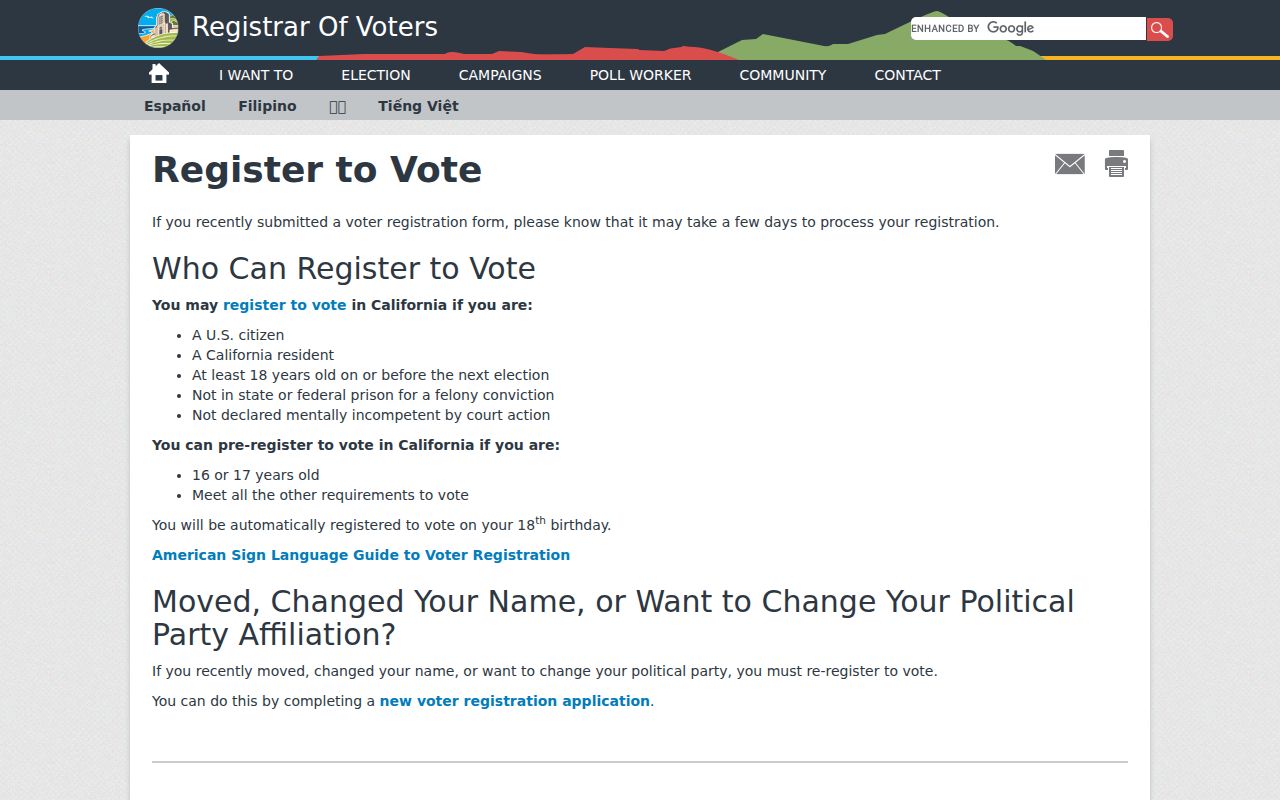
Voter registration has a stricter public-records boundary than deeds or court indexes. The San Diego Registrar tells voters they can check registration status and keep address or party information current. California's full voter file is available only through an application process for approved purposes, and confidential voter records are excluded.
The San Diego Registrar page also states that commercial use is prohibited by law and is a misdemeanor. Driver license number, Social Security number, and voter signature cannot be released for these purposes. Open-record access should not treat voter rolls as a general address directory; the full voter detail belongs on the Escondido voter registration records page.
The San Diego Registrar registration page gives the county voter-status and data-use notices.
That office is the county election contact, while statewide file applications route through the California Secretary of State.
Escondido Records History
San Diego County records go back to California's early county government in 1850. The recorder function was created by state statute for all counties that year, and the San Diego History Center notes that the recorder was sometimes combined with auditor and county clerk functions before becoming independent in 1880. County Archives, established in 2020 inside ARCC, now preserves permanent-retention records with enduring value.
Early deed material is visible through OAC finding aids, including San Diego County Recorder deeds from 1850 to 1916, with a bulk run from 1850 to 1868. For Escondido-specific historical research, pair the archive route with the Pioneer Room's city directories, newspapers, Sanborn maps, naturalization records, and probate orders. Note: a historical index may prove that a record group exists even when no modern web image is available.